
White Paper
Investigation of Rb Interference on Sr Isotope Analysis Using MC-ICP-MS
Introduction
Strontium (Sr) has four naturally occurring stable isotopes: 84Sr, 86Sr, 87Sr, and 88Sr. The isotopic composition of the 87Sr/86Sr ratio exhibits geographical variation on both local and global scales. This variation arises from the radioactive decay of 87Rb to 87Sr, making the 87Sr/86Sr ratio a valuable tool in disciplines such as geochronology, provenance studies, and archaeology. However, precise analysis of Sr isotope ratios using multi-collector inductively coupled plasma mass spectrometry (MC-ICP-MS) necessitates the complete removal of rubidium (Rb) from samples due to isobaric and matrix interferences caused by 87Rb.
Post-purification, even at picogram-per-liter (ppt) levels, residual Rb can introduce significant biases in 87Sr/86Sr measurements. To ensure precise and accurate results, Rb must be completely eliminated before MC-ICP-MS analysis. This study evaluates two approaches to mitigate Rb interference: (i) the Rb isotopic correction method and (ii) the ion chromatography (IC) separation method.
Methodology
1. Rb Isotopic Correction Method
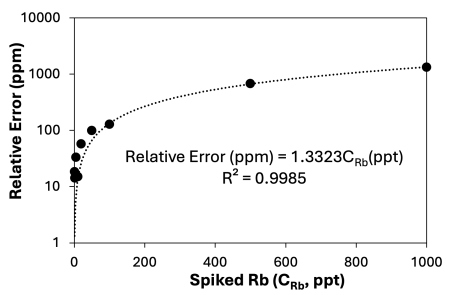
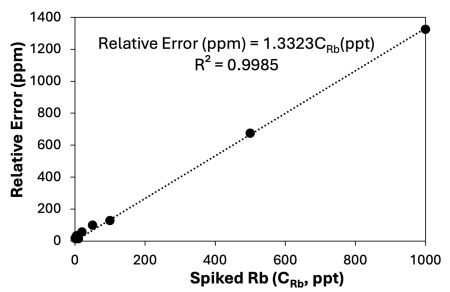
To assess the tolerable Rb concentration using the Rb isotopic correction method, NIST987 standard samples spiked with varying concentrations of Rb were analyzed for 87Sr/86Sr ratios. As shown in Figure 1, each 1 ppt of residual Rb introduced a relative error of 1.3 parts per million (ppm) in the 87Sr/86Sr ratio. Beyond 10 ppt Rb, the bias became increasingly significant, rendering the correction method less reliable.
2. Ion Chromatography (IC) Separation Method
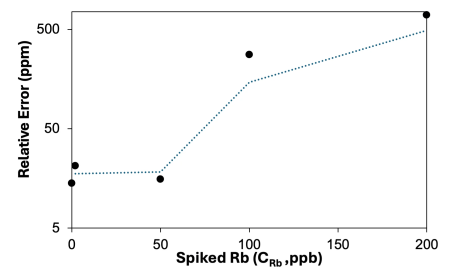
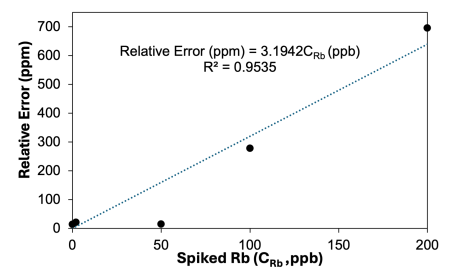
An ion chromatography method was optimized for the separation of Sr from Rb using ICP-QMS. The optimized IC system, coupled with an auto-sampler and MC-ICP-MS, was used to analyze Rb-spiked NIST987 samples. As illustrated in Figure 2, this method demonstrated no significant bias in 87Sr/86Sr ratios up to 50 parts per billion (ppb) of Rb. Beyond this concentration, a relative error of approximately 3.1 ppm per ppb of Rb was observed. Notably, the IC method exhibited a tolerance to Rb interference approximately 429 times higher than the Rb correction method, where every 1 ppb Rb caused a relative error of 1330 ppm.
Analysis of BCR-2 and Cinnamon Samples
BCR-2 (SRM) and cinnamon samples were digested, and Sr was purified using a column procedure. The purified Sr fractions were analyzed for 87Sr/86Sr ratios using both the Rb correction and IC methods.
As presented in Table 1, the relative error for the Rb correction method was significantly higher (3669 ppm) compared to that of the IC method (-32 ppm) for the BCR-2 sample. This discrepancy is attributed to the residual Rb concentration of approximately 3 ppb post-purification. For all tested samples, 87Sr/86Sr ratios were consistently higher with the Rb correction method than the IC method, highlighting the superior performance of the IC approach.
Table 1. Measured 87Sr/86Sr values with the Rb correction method and the IC method in cinnamon samples and relative errors (RE) for the BCR-2 sample.
|
|
Rb Correction Method |
|
IC Method |
|
Literature value (4) |
||
|
Sample |
87Sr/86Sr |
RE (ppm) |
|
87Sr/86Sr |
RE (ppm) |
|
87Sr/86Sr |
|
SRM(BCR-2) |
0.70760 |
3669 |
|
0.70499 |
-32 |
|
0.70501 |
|
Cinnamon1 |
0.72522 |
|
|
0.72513 |
|
|
|
|
Cinnamon2 |
0.73048 |
|
|
0.73034 |
|
|
|
|
Cinnamon3 |
0.72960 |
|
|
0.72934 |
|
|
|
Furthermore, Figure 3 depicts an ion chromatogram of the BCR-2 sample obtained using the IC-MC-ICP-MS method, clearly demonstrating the effective separation of Sr from Rb. This ensured accurate measurement of Sr isotope ratios with MC-ICP-MS.
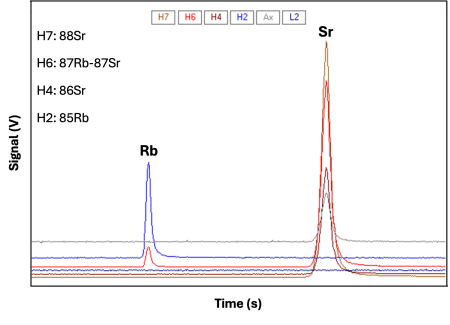
Figure 3. Ion chromatogram of the BCR-2 sample with the IC-MC-ICP-MS.
Conclusion
This study underscores the limitations of the Rb correction methods and emphasizes the robustness of the ion chromatography method for Sr isotope analysis. The IC method significantly reduces Rb interference, enabling highly accurate and precise determination of 87Sr/86Sr ratios, even in the presence of low levels of residual Rb. These findings have broad implications for applications in geochronology, provenance studies, and other fields requiring precise isotopic measurements.
Acknowledgments
The authors thank the technical support staff for their assistance in setting up the IC-MC-ICP-MS system and conducting sample analyses.
References
- Argentino, Claudio & Lugli, Federico & Cipriani, Anna & Panieri, Giuliana. (2021). Testing miniaturized extraction chromatography protocols for combined 87Sr/86Sr and δ88/86Sr analyses of pore water by MC‐ICP‐MS. Limnology and Oceanography: Methods. 19. 10.1002/lom3.10435 .
- B. Puente-Berdasco, J. Rodriguez, D. Ballesteros, A. Painchault,C. Nehme, D. Mouralis, J. I. Gil-Ibarguchi, A. Martinized and J. I. Garcia Alonso (2022). Measurement of 87Sr/86Sr in limestones after acid leaching and direct injection in a liquid chromatograph coupled to a multicollector ICP-MS. J. Anal. At. Spectrom.,37, 194. DOI: 10.1039/d1ja00340b.
- LIU Wen-Gang, LI Zhi-Dan, WEI Shuang, CHEN Ji , LIU Yu, AO Cong, XIAO Zhi-Bin, ZHOU Hong-Ying , LIU Hui (2019). Rapid Separation and Precise Determination of Strontium Isotopic from Geological Samples with High Rubidium/Strontium Ratios, Chinese J. Anal. Chem.,47(7): 1054–1060. DOI: 10.1016/S1872-2040(19)61172-2.
- Tu-Han Luu, Pamela Gutierrez, Edward C. Inglis, Daniel Roberts , Catherine Chauvel (2022). High-precision Sr and Nd isotope measurements using a dynamic zoom lens-equipped thermal ionisation mass spectrometer. Chem. Geology, 611, 121078. https://doi.org/10.1016/j.chemgeo.2022.121078.
Accurate Sr Isotope Ratio Measurements with Multicollector Inductively Coupled Plasma Mass Spectrometry (MC-ICP-MS)
Strontium (Sr) has four naturally occurring stable isotopes, 84Sr, 86Sr, 87Sr, and 88Sr. The isotopic composition of 87Sr/86Sr varies geographically on a local and global scale. The natural variation in the 87Sr/86Sr ratio is derived from the radioactive decay of 87Rb to 87Sr. The relationship between Rb concentration and the age of the sample allows the 87Sr/86Sr isotope abundance ratio to be a powerful tool for many disciplines such as geochronology, provenance studies, and archaeology (1).
For accurate analysis of Sr isotope ratios by MC-ICP-MS, the separation of Sr from Rb is mandatory before their measurement due to isobaric and matrix interferences (2). Purification of Sr from sample matrices is successfully performed using ion exchange and Sr-specific resins. However, even though more than 99% of the Rb is removed from the Sr, the solution would have ppt-level Rb after purification. The isobaric interference of 87Rb on 87Sr would directly affect the accuracy of analysis of the 87Sr/86Sr ratio even in the presence of ppt level of Rb. Therefore, to ensure high precision and accurate determination of the Sr isotope ratio, Rb must be removed from the solution completely before MC-ICP-MS measurements (3).
In this study, we investigated the following two options to eliminate the effect of Rb isobaric interferences on Sr isotopes after purification of Sr .
i) Rb Correction Method
To see tolerable Rb concentration of the Rb correction method on the 87Sr/86Sr, the Rb-spiked NIST987 samples were analyzed for the 87Sr/86Sr ratios using the Rb correction method. As seen in Figure 1, every 1 ppt Rb causes 1.3 ppm relative error, even if the Rb correction method is used. After 10 ppt Rb, the bias (error) on 87Sr/86Sr becomes significant.
ii) Ion Chromatography Method
An ion chromatograph (IC) method was optimized for the separation of Sr from Rb using ICP-QMS. The optimized IC with an auto sampler was coupled to MC-ICP-MS. To see the efficiency of the IC-MC-ICP-MS method on the accuracy of Sr isotopes, Rb-spiked NIST987 samples were analyzed for Sr isotopes. As seen from Figure 2, there is no significant bias on 87Sr/86Sr up to 50 ppb Rb. After 50 ppb Rb, the bias on the 87Sr/86Sr becomes significant. Every 1 ppb Rb causes roughly 3.1 ppm relative error with the IC method, while every 1 ppb Rb causes 1330 ppm relative error with the Rb correction method. This data indicates that the IC method is about 429 times more tolerable to Rb interference on the 87Sr/86Sr ratio than the Rb correction method.
Sr isotope ratio analysis in BCR-2 (SRM) and cinnamon samples with the Rb correction method and the IC Method
BCR-2 and cinnamon samples were digested, and Sr in the samples was purified using a column procedure. Sr isotope ratios in the purified samples were measured using the Rb correction method and IC-MC-ICP-MS. As seen in Table 1, the relative error (RE) with the Rb correction method (3669 ppm) was much higher than that of the IC method (-32 ppm) since the BCR-2 sample has about 3 ppb Rb after purification with a column procedure. As expected, for all samples, 87Sr/86Sr ratios were higher with the Rb correction method than with the IC method. Moreover, Figure 3 shows an ion chromatogram of the BCR-2 sample with the IC-MC-ICP-MS method. It is seen that Sr is separated from Rb with the IC method, which ensures accurate Sr isotope measurements of the BCR-2 sample with MC-ICP-MS.
Table 1. Measured 87Sr/86Sr values with the Rb correction method and the IC method in cinnamon samples and relative errors (RE) for the BCR-2 sample.
|
|
Rb Correction Method |
|
IC Method |
|
Literature value (4) |
||
|
Sample |
87Sr/86Sr |
RE (ppm) |
|
87Sr/86Sr |
RE (ppm) |
|
87Sr/86Sr |
|
SRM(BCR-2) |
0.70760 |
3669 |
|
0.70499 |
-32 |
|
0.70501 |
|
Cinnamon1 |
0.72522 |
|
|
0.72513 |
|
|
|
|
Cinnamon2 |
0.73048 |
|
|
0.73034 |
|
|
|
|
Cinnamon3 |
0.72960 |
|
|
0.72934 |
|
|
|
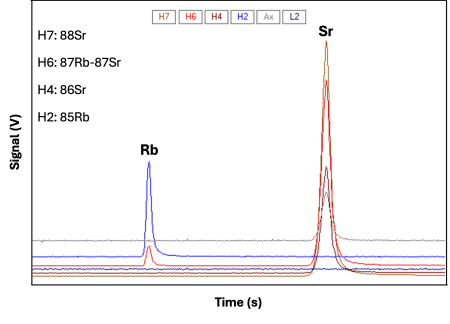
Figure 3. Ion chromatogram of the BCR-2 sample with the IC-MC-ICP-MS.
References
- Argentino, Claudio & Lugli, Federico & Cipriani, Anna & Panieri, Giuliana. (2021). Testing miniaturized extraction chromatography protocols for combined 87Sr/86Sr and δ88/86Sr analyses of pore water by MC‐ICP‐MS. Limnology and Oceanography: Methods. 19. 10.1002/lom3.10435.
- B. Puente-Berdasco, J. Rodriguez, D. Ballesteros, A. Painchault,C. Nehme, D. Mouralis, J. I. Gil-Ibarguchi, A. Martinized and J. I. Garcia Alonso (2022). Measurement of 87Sr/86Sr in limestones after acid leaching and direct injection in a liquid chromatograph coupled to a multicollector ICP-MS. J. Anal. At. Spectrom.,37, 194. DOI: 10.1039/d1ja00340b.
- LIU Wen-Gang, LI Zhi-Dan, WEI Shuang, CHEN Ji , LIU Yu, AO Cong, XIAO Zhi-Bin, ZHOU Hong-Ying , LIU Hui (2019). Rapid Separation and Precise Determination of Strontium Isotopic from Geological Samples with High Rubidium/Strontium Ratios, Chinese J. Anal. Chem.,47(7): 1054–1060. DOI: 10.1016/S1872-2040(19)61172-2.
- Tu-Han Luu, Pamela Gutierrez, Edward C. Inglis, Daniel Roberts , Catherine Chauvel (2022). High-precision Sr and Nd isotope measurements using a dynamic zoom lens-equipped thermal ionisation mass spectrometer. Chem. Geology, 611, 121078. https://doi.org/10.1016/j.chemgeo.2022.121078.